Canonical Question
Pulmonary Circulation
Master answer
Gravity Dependent Processes
- Low pressure circuit:
- pressure drop of ~10mmHg from RV (15mmHg) to LA (5mmHg)
- PAP is just sufficient to raise blood to top of lung
- Blood flow in upright lung varies due to gravity effect (hydrostatic Pressure)
- Lung divided into vertically into 4 zones (West Zones)
- Zone 1 not present in normal lungs
- manifests in Positive pressure ventilation, Hypovolaemia, eg. haemorrhage
- Zone 4 appears in the presence of interstitial pressures or at very low lung volumes
- Zone 1 not present in normal lungs
- Normal balance between the zones varies based on:
- changes in posture
- changes in airway pressures due to anatomical changes / disease, ventilation changes
- changes in lung volume:
- At extremes pulmonary capillaries are linearly stretched and collapse as may occur with hyperinflation.
- At very low lung volumes, extra-alveolar blood vessels become compressed and flow reduces (Zone 4).
- changes in pulmonary vascular pressures related to cardiac factors or pulmonary vascular disease
- There are alternate theories explaining the heterogeneity in pulmonary perfusion and ventilation in both health and disease, which suggest that gravity has a less important role in the variation of regional distribution
- for e.g: The underlying structure of the bronchial and pulmonary vascular anatomy with non-symmetrical branching (Structural theory)
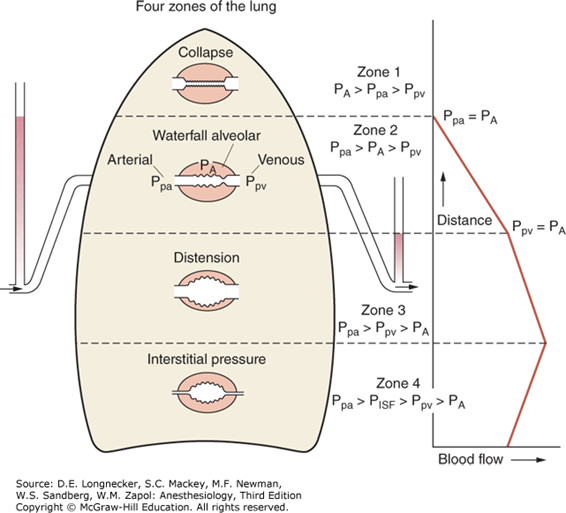
West Zone 1
\[ P_A \; > \; P_a \; > \; P_v \]
- Not present in the normal lung
- Nil flow of blood to apical zones
- ↑alveolar dead space → High V/Q ratio
- Increased in:
- Hypotension, PE, Hyperinflation of lung with PPV
- Minimal change in PaO2 with increased West Zone 1 as Hb fully loaded
- Slight increase in PaCO2 as there is decreased apical perfusion, however this is compensated for by the increased RR chemoreceptor change: Minimal change in PaCO2
- Hypotension, PE, Hyperinflation of lung with PPV
West Zone 2
\[ P_a \; > \; P_A \; > \; P_v \]
- Starling Resistor Mechanism
- ↑ hydrostatic P or ↓ Alveolar pressure → Pa > PA → capillary opens → flow → ↓ hydrostatic P ° to flow → Pa < PA → capillary closes
- Blood flow tends to ‘flutter’ (pulsatile flow)
- decreased in diastole, increased in systole.
- Increased in inspiration, decreased in expiration
- Present from the apex of the upright lung → 10cm above the level of the heart
West Zone 3
\[ P_a \; > \; P_v \; > \; P_A \]
- Blood flow is constant due to the maintenance of arterio-venous pressure gradient
- Alveolar pressure is not a factor determining blood flow in this zone
- 10cm above the heart → bases of upright lung
- Effect of weight of lung ↓PA
- Hydrostatic pressure is maximal (~25mmHg)
- Low V/Q ratio
- Contributes to venous admixture
West Zone 4
\[ P_a \; > \; P_i \; > \; P_v \; > \; P_A \]
- Interstitial pressure acts as a Starling resistor for pulmonary blood flow.
- It is seen when interstitial pressure is high (e.g due to pulmonary oedema).
- Also seen at very low lung volumes, where extra-alveolar blood vessels become compressed and flow reduces.
Effect of ↑P in pulmonary vessels
- Pulmonary circulation is low pressure circuit – ↑pressure 2° ↑PAP / PVP (LA) pressure
- Response in pulmonary vasculature is:
- Recruitment of closed capillaries
- Distension (↑caliber) of vessels
- Increased pressure delivered to the arterioles causes dilation and decreases resistance to flow, increasing flow by as much as twice what would be expected due to pressure alone
- Pulmonary arteries are approximately ½ as distensible as veins; this buffers pressure changes transmitted to the alveolar capillaries and also permits the arteries to adopt a reservoir function
\[ Vascular \; distensibility \; = {{increase \; in \; volume} \over {Increase \; in \; pressure\; \times \; original \; volume}} \]
- Net effect of recruitment and distension is bufering of pressure rise (↓pressure of pulmonary circulation) until these processess are exhausted or in the presence of pulmonary capillary disease
Gladwin 2016
Exam appearances
| Exam | Exact wording | Relationship | Success |
|---|---|---|---|
| 2008B Q24 | Describe the gravity dependent processes which affect pulmonary blood flow (70% of marks). Describe the changes that result from an acute increase in pressure in the pulmonary vessels (30% of marks). | historical_member | — |