Canonical Question
Cell Transport
Master answer
Transmembrane Transport Mechanisms
[table id=E-01 /]
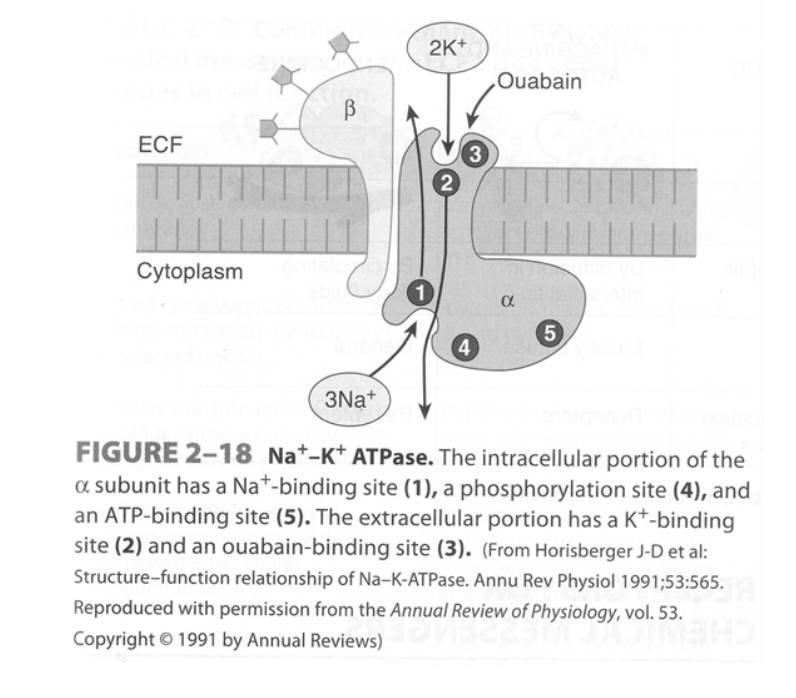
Na+/K+ – ATPase pump
- Found in virtually all cells of the body – It is a heterodimer integral membrane protein that spans the entire membrane:
- α-subunit (larger subunit) – Binds Na+, ATP and PO43- intracellularly, and K+ and ouabain/glycosides extracellularly
- β-subunit (smaller subunit) – A glycoprotein
- Functions as an “electrogenic pump” as it extrudes 3 Na+ from the cell and takes in 2 K+ per ATP hydrolysed
- Process of pump function:
- Na+ and ATP bind to α-subunit intracellularly
- ATP is hydrolysed to ADP and the phosphate is transferred to an Asp-phosphorylation site
- Conformational change of the protein causes Na+ to be extruded into ECF
- K+ binds to the α-subunit extracellularly
- Dephosphorylation of the Asp-phosphorylation site causes the protein to return to its resting conformation, which then transports K+ intracellularly
- Pump function is inhibited by ouabain and digitalis glycosides
JC / Mooney / Bianca 2019
Exam appearances
| Exam | Exact wording | Relationship | Success |
|---|---|---|---|
| 2022A Q02 | Explain the mechanisms of transport of substances across cell membranes including appropriate examples (75% marks). Outline the structure and function of the Na+/K+-ATPase pump (25% marks). | historical_member | 61.00% |