Canonical Question
Discuss the factors affecting pulmonary vascular resistance.
Master answer
- Vascular resistance is the resistance to blood flow for a given pressure gradient across the vessels
- Pulmonary vasculature is a high capacitance, low pressure system
- Pulmonary artery pressures: 25/8 (MAP 15)
- Pulmonary Vascular Resistance (PVR)
- ~ 1/10th of SVR
- ~ 0.25-1.6 mmHg/L/min (or) 20-120 dynes.Sec.Cm-5
- Factors Affecting Pulmonary Vascular Resistance:
- Recruitment and Distension
- Gravity
- Autonomic Innervation
- Volume
- Hypoxia, Hypercapnoea, Acidosis
- Local Mediators
1. Recruitment and distension:
- At normal pressure and flows, most capillaries are either partially or completely collapsed
- At higher pressures, decrease in resistance due to
- Distension of partially collapsed capillaries
- Recruitment of completely collapsed capillaries
2. Gravity
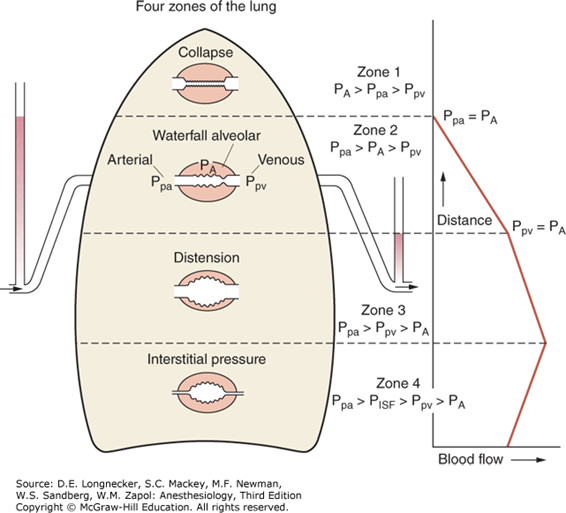
- Divided into West Zones based on relationship between Alveolar pressure (PA) Arterial pressure (Pa) Venous pressure (Pv) Interstitial pressure (Pi)
- West Zones 1,2,3: Due to changes in hydrostatic pressure when pumping to top of lung vs. bottom of lung
| West Zone | Pressure Relationships | Physiology | Location |
|---|---|---|---|
| Zone 1 | PA > Pa > Pv | No flow of blood, as arterial pressure completely opposed by alveolar pressure | not seen in normal lung |
| Zone 2 | Pa > PA > Pv | Resistance to flow is determined by alveolar pressure (Starling resistor effect) | about 3cm above the heart |
| Zone 3 | Pa > Pv > PA | Resistance to flow is determined by venous pressure Venous pooling causes increased distension of pulmonary capillaries | majority of healthy lung |
| Zone 4 | Pa > Pi > Pv > PA | Low lung volume causes narrowing of extra-alveolar vessels | Lung bases at low lung volume or in pulmonary edema |
3. Autonomic innervation:
- Sympathetic innervation from sympathetic trunk
- Noradrenaline
- α1 (vasoconstriction) and β (vasodilation) receptors
- α effects dominate (vasoconstricton)
- Parasympathetic innervation from vagus nerve
- Acetylcholine (M3 receptors)
- Cause vasodilation
4. Volume
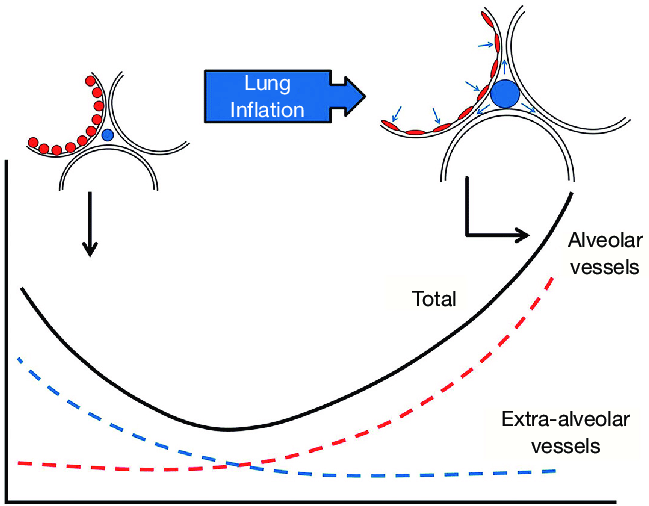
- Extra-alveolar vessels are stretched laterally by increased volumes
- Compressed by low volumes
- Pulmonary capillaries are stretched longitudinally by increased volumes, decreasing
radius -> more resistance - PVR is a balance of these two effects
- PVR is lowest at functional residual capacity
5. Hypoxia, Hypercapnoea, Acidosis
- Hypoxia:
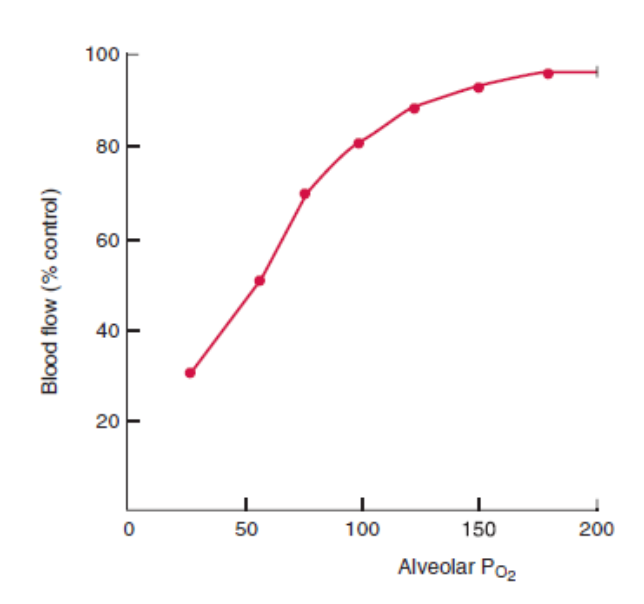
- Alveolar (not arteriolar) hypoxia causes local vasoconstriction of pulmonary vessels
- This limits perfusion of underventilated lung regions, reducing shunt
- There is a similar, but less potent, effect of hypercapnoea and acidosis on vascular tone, reducing perfusion of hypoventilated regions
6. Local mediators:
- Dilators:
- Nitric oxide
- Prostacycline
- Isoprenaline
- Constrictors:
- Histamine
- Serotonin
- Endothelins
Mooney 2016
Exam appearances
| Exam | Exact wording | Relationship | Success |
|---|---|---|---|
| 2009B Q16 | Discuss the factors affecting pulmonary vascular resistance. | historical_member | — |